The average attorney bills between $250 and $500 per hour, according to the Clio 2023 Legal Trends Report. One hour of downtime at a 10-attorney firm means $2,500 to $5,000 in lost billable time. That's why law firms need managed IT, not the break-fix model that most small firms still rely on.
If your firm's IT strategy is "call someone when something breaks," you're paying more than you think. This post breaks down the real cost of reactive IT for law firms, what the managed model actually looks like, and how to tell if your firm has outgrown the break-fix approach.
A note: This article discusses IT management models and references ABA compliance requirements from an IT perspective. Every firm's obligations depend on practice area, jurisdiction, and client base. This is IT guidance, not a substitute for your own legal analysis.
What break-fix IT actually costs a law firm
Break-fix IT is exactly what it sounds like: something breaks, you call a technician, they fix it, you get a bill. It feels simple, and for a solo practitioner with one laptop, it might be fine. But for any firm with more than a handful of attorneys and staff, the hidden costs add up fast.
Emergency hourly rates. Most break-fix technicians charge $150 to $300 per hour, with higher rates for after-hours or urgent calls. When your document management system crashes at 3 PM on a filing deadline, you're paying premium rates for reactive work that proactive monitoring would have prevented.
Downtime during critical moments. Court deadlines don't wait for your IT guy to call back. According to Gartner research, IT downtime is expensive for any business, but for a law firm the stakes are even higher because missed filing deadlines can lead to sanctions, malpractice claims, or lost cases.
Security gaps between visits. A break-fix technician isn't monitoring your network between calls. That means no one is watching for phishing attempts, failed login attempts, or outdated software with known vulnerabilities. The 2024 ABA TechReport found that 29% of law firms have experienced a security breach. Without continuous monitoring, your firm is an easier target.
The billable hours problem
Every hour your attorneys spend dealing with IT problems is an hour they're not billing clients. This is the math that makes break-fix IT so expensive for law firms, even when the repair bills seem manageable.
Consider a firm with 10 attorneys averaging $350 per hour. If each attorney loses just 30 minutes per week to IT issues (slow computers, printer problems, email outages, VPN failures), that's 5 hours of lost billable time per week across the firm. At $350 per hour, that's $1,750 per week or more than $91,000 per year in revenue that walks out the door.
That number doesn't include the time your office manager spends troubleshooting, the cost of missed deadlines, or the client frustration when your systems go down during a critical matter. In our experience working with Kansas City firms, technology problems regularly cost attorneys several hours per month in lost productivity.
Managed IT doesn't eliminate every tech hiccup, but it drastically reduces unplanned downtime. Proactive monitoring catches failing hardware before it fails, patches vulnerabilities before they're exploited, and keeps systems running so your team can focus on actual legal work. For firms ready to make the switch, dedicated IT support for law firms is built around billable hours, not ticket queues.
Compliance gaps from reactive IT
The ABA's Model Rules of Professional Conduct aren't optional. Rule 1.1 requires attorneys to stay competent with the technology they use. Rule 1.6 requires "reasonable efforts" to prevent unauthorized access to client information. These rules apply regardless of your firm's size.
A break-fix IT provider doesn't help you meet these obligations. They show up when something is already broken. They're not auditing your security posture, testing your backups, or making sure your team has multi-factor authentication enabled.
The 2024 ABA TechReport also found that only 40% of law firms have an incident response plan in place. If your IT support is purely reactive, there's a good chance your firm falls into the 60% without one.
What managed IT looks like for a law firm
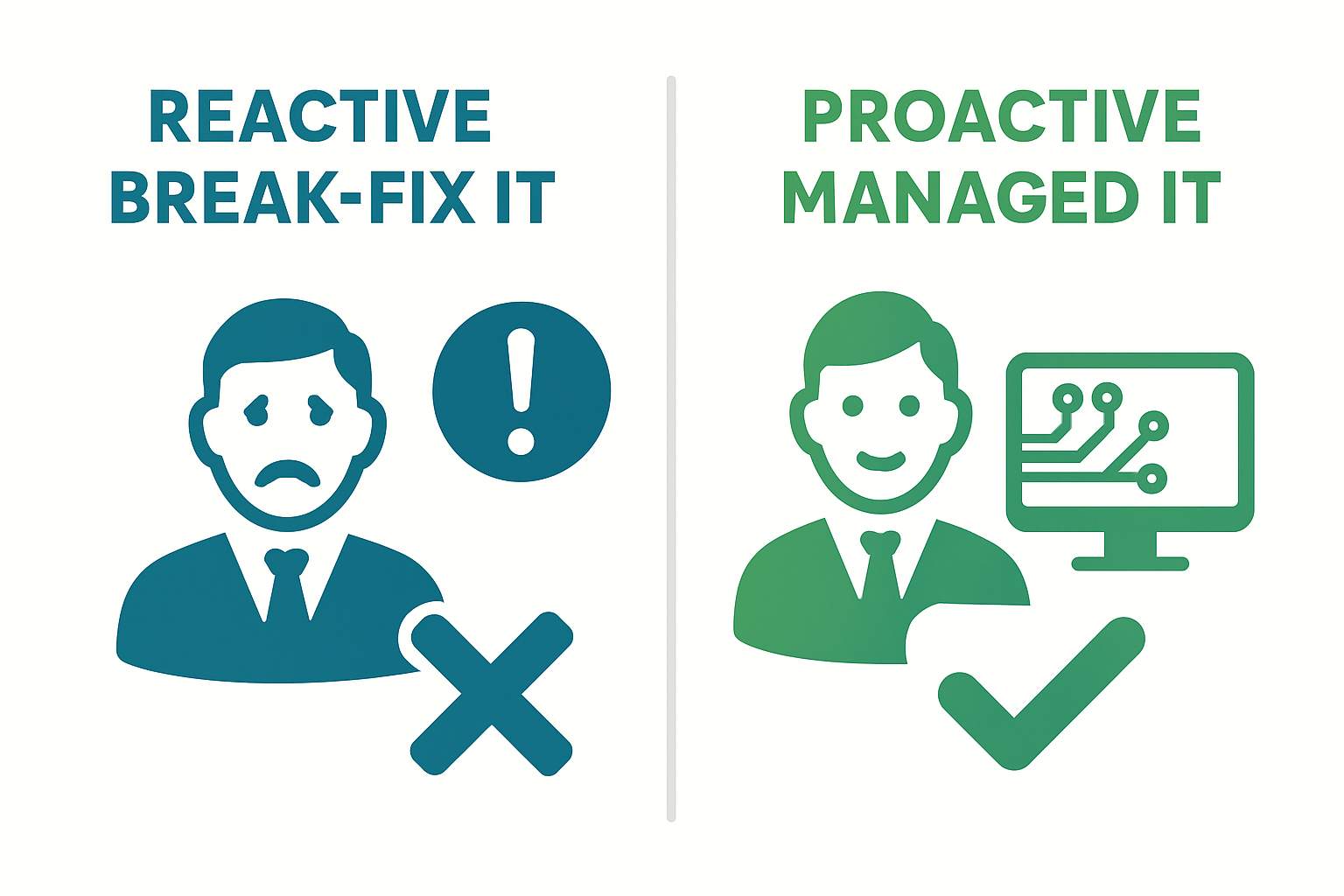
Managed IT is a proactive model where a provider monitors, maintains, and supports your firm's technology for a flat monthly fee. Instead of waiting for something to break, the provider works to prevent problems before your team ever notices them.
For a law firm, managed IT typically includes:
- Automated system monitoring that catches issues before they cause downtime
- Same-day help desk support so your team gets answers fast, not in 48 hours
- Endpoint security and threat detection on every device in the firm
- Encrypted, tested backups with a clear recovery plan (not just "we back up nightly" with no proof it works)
- Legal software support for platforms like Clio, PracticePanther, and other practice management tools
- Compliance guidance aligned with ABA Rules 1.1 and 1.6
- Flat, predictable monthly pricing with no surprise bills when something goes wrong
The biggest difference from break-fix isn't any single feature. It's the relationship. A managed IT provider has a financial incentive to keep your systems running smoothly because they're paid the same amount regardless. A break-fix technician makes more money when more things break. That misalignment matters.

How to know if your firm has outgrown break-fix
Not every firm needs to make this switch right now. But if you recognize three or more of these warning signs, it's probably time:
- Your team experiences unplanned downtime more than once a month
- You don't know when your backups were last tested (or if they'd actually work)
- Your firm has no written cybersecurity policy
- Staff regularly waste time troubleshooting their own tech issues
- You're paying surprise IT bills that vary wildly month to month
- Your current IT person takes days to respond
- You couldn't confidently answer an ABA ethics audit about your data security practices
If that list feels familiar, your firm has likely outgrown the break-fix model. The question isn't whether managed IT costs more than zero support. It's whether the cost of continuing without it is higher. For most firms above 5 people, it is.
Lockbaud provides IT support for law firms across the Kansas City metro, replacing reactive IT with proactive support. If your firm is outside the KC area, our managed IT services for law firms page covers how we support firms nationally. We handle cybersecurity for law firms, legal software support, practical security guidance, and responsive help desk. If you're trying to figure out what managed IT should actually cost, we're happy to walk through the numbers with you. No pressure, just an honest conversation.
Sources: Clio 2023 Legal Trends Report, 2024 ABA TechReport, Gartner IT Downtime Research, International Legal Technology Association (ILTA)
Frequently Asked Questions
What is the difference between break-fix and managed IT?
Break-fix IT means you call a technician when something breaks and pay by the hour. Managed IT is a proactive model where a provider monitors, maintains, and supports your systems for a flat monthly fee. Managed IT catches problems before they cause downtime, while break-fix only reacts after something has already failed.
How much does IT downtime cost a law firm?
It depends on the size of your firm and your billing rates. For a 10-attorney firm where attorneys average $350 per hour, one hour of downtime costs $3,500 in lost billable time. For law firms with court-imposed deadlines, the cost can be even higher when missed deadlines lead to sanctions or malpractice exposure.
Can a small law firm afford managed IT services?
Yes. Most managed IT providers charge between $100 and $200 per user per month. For a 5-attorney firm, that's roughly the cost of one emergency break-fix visit per month. The difference is that managed IT prevents most of those emergencies from happening, making it more cost-effective over time.
How long does it take to switch IT providers?
A typical transition takes 2 to 4 weeks. Lockbaud plans onboarding carefully so your team can keep working while we set up monitoring, security, and support in the background.
What should managed IT include for a law firm?
At minimum: automated system monitoring, responsive help desk support, endpoint security and threat detection, encrypted backups with tested recovery, legal software support (Clio, PracticePanther, etc.), and practical security guidance that helps firms take professional obligations seriously. A good provider will also offer predictable pricing without surprise bills.